About the Journal
1. INTRODUCTION
The Journal of Research in Economics and Finance Management (JREFM) is a peer-reviewed, biannual research journal. Print ISSN: 2959-099X, Online ISSN: 2959-1007, published by Contemporary Science Research Publisher (SMC-PVT) Ltd. JREFM is dedicated to advancing scholarly knowledge and academic excellence in the fields of Economics, Finance, and Accounting through high-quality research publications and intellectual collaboration.
JREFM provides an international platform for researchers, academicians, professionals, policymakers, and students to disseminate innovative research, theoretical developments, and empirical findings that contribute to sustainable academic, financial, and economic development.
2. PURPOSE
The Journal of Research in Economics and Finance Management (JREFM) aims to identify, explore, and develop intellectual human capital in the fields of Economics, Finance, and Accounting. The journal is committed to achieving a significant position in global academic research through impactful scholarly contributions.
JREFM provides an electronic platform for researchers, academics, professionals, and students to publish their research work and enhance its global visibility and readership. The journal also supports the development of analytical, financial, research, and knowledge management skills among contributors and readers.
Through its activities, JREFM promotes knowledge transfer and academic collaboration among global intellectual communities to support economic growth, financial innovation, and sustainable development.
3. VISION
JREFM envisions a global academic environment where intellectual capital in Economics, Finance, and Accounting is valued, developed, and effectively utilized through the creation, dissemination, and protection of knowledge.
The journal seeks to highlight the contributions of researchers, scholars, and professionals by promoting excellence in economic and financial research and fostering global academic collaboration.
4. MISSION
The mission of JREFM is to develop a globally recognized platform for academic publishing in the fields of Economics, Finance, and Accounting.
JREFM is committed to:
- Promoting ethical, rigorous, and high-quality research practices.
- Encouraging innovative and interdisciplinary research in economics and finance.
- Supporting international academic collaboration and knowledge exchange.
- Enhancing teaching, research, and professional development through evidence-based studies.
- Contributing to global economic understanding and sustainable financial development.
5. AIM
The aim of the Journal of Research in Economics and Finance Management (JREFM) is to advance scholarly research and academic excellence in the fields of Economics, Finance, and Accounting by providing a high-quality platform for the publication and dissemination of original research.
JREFM specifically aims to:
- Promote high-quality research and intellectual contribution in economics, finance, and accounting disciplines.
- Encourage empirical, theoretical, and applied research addressing contemporary economic and financial issues.
- Provide researchers, academicians, and professionals with opportunities for academic publication and global visibility.
- Facilitate collaboration among universities, research institutions, policymakers, and industry professionals.
- Support innovative analytical approaches and evidence-based decision-making in economics and finance.
- Contribute to knowledge sharing, policy development, and sustainable economic and financial advancement.
6. Research Journal Team and Their Roles
6.1.Patron
The Patron serves as the journal's chief patron and institutional head. The Patron provides strategic support, institutional guidance, and oversight to ensure the journal’s sustainability, academic integrity, and long-term growth. The Patron also promotes the journal’s vision and strengthens its academic and professional reputation nationally and internationally.
6.2 Chief Editor
The Chief Editor is responsible for the overall academic leadership and management of JREFM. The role includes developing editorial policies, maintaining publication quality, ensuring compliance with ethical standards, and making final decisions regarding manuscript acceptance or rejection. The Chief Editor also supervises the editorial team and ensures the journal achieves its academic objectives and indexing goals.
6.3 Editor
The Editor oversees the peer-review and editorial process within their assigned subject areas. The Editor evaluates submitted manuscripts, assigns reviewers, assesses reviewer comments, and recommends editorial decisions while ensuring the quality, originality, and relevance of published research.
6.4 Managing Editor
The Managing Editor manages the journal’s day-to-day editorial operations and coordinates the complete publication workflow. Responsibilities include managing manuscript submissions, maintaining communication among authors, reviewers, and editors, monitoring publication timelines, and ensuring compliance with journal policies and publication standards.
6.5 Associate Editor
The Associate Editor assists the Chief Editor and Editors in managing the peer-review process. The Associate Editor supports manuscript evaluation, reviewer selection, editorial correspondence, and quality assurance to ensure efficient and transparent editorial practices.
6.6 Section Editor
The Section Editor is responsible for handling manuscripts within a specialized research domain covered by JREFM. The Section Editor ensures that submitted manuscripts align with the journal’s scope and academic standards while providing subject-specific guidance during the review process.
6.7 Copy Editor
The Copy Editor reviews accepted manuscripts for language accuracy, grammar, clarity, consistency, referencing style, formatting, and overall readability. The Copy Editor ensures that manuscripts comply with the journal’s publication and formatting guidelines before final publication.
6.8 Editorial Board
The Editorial Board comprises experienced academicians, researchers, and professionals from relevant disciplines. Members provide academic guidance, support policy development, assist in reviewer recommendations, promote the journal, and contribute to maintaining scholarly standards and research quality.
6.9 Reviewer
Reviewers are subject experts responsible for evaluating the quality, originality, relevance, methodology, and scholarly contribution of submitted manuscripts. Reviewers provide constructive feedback and recommendations to support editorial decisions and enhance the quality of research publications.
6.10 Advisory Board
The Advisory Board comprises distinguished scholars and professionals who provide strategic and academic guidance to advance JREFM. The Advisory Board advises on emerging research areas, publication strategies, international collaborations, and journal improvement initiatives.
6.11 Production Team
The Production Team manages the technical and production aspects of journal publication. Responsibilities include manuscript formatting, layout design, proofreading, DOI management, online publication, archiving, and ensuring the timely release of journal issues.
6.12 Marketing and Outreach Team
The Marketing and Outreach Team promotes JREFM among academic institutions, researchers, and professional communities through digital platforms, conferences, workshops, and academic networking activities. The team also manages the journal’s branding, visibility, and outreach initiatives.
6.13 Technical Support Team
The Technical Support Team is responsible for maintaining the journal’s online systems and digital infrastructure. This includes website management, online submission systems, indexing support, database maintenance, and providing technical assistance to authors, reviewers, and editors.
7. Appointment of the Research Journal Team
The Patron appoints the Chief Editor of the Journal of Research in Economics and Finance Management (JREFM). The Chief Editor, in consultation with the editorial leadership, is responsible for the appointment of Editors, Associate Editors, Section Editors, Editorial Board members, Reviewers, and other journal management teams based on their academic expertise, research contributions, and professional experience.
Appointments are made to ensure transparency, academic quality, diversity, and adherence to the journal’s objectives and ethical standards.
8. Frequency of the Journal
The Journal of Research in Economics and Finance Management (JREFM) is a bi-annual peer-reviewed research journal. The journal publishes two issues per year, providing a regular platform for the dissemination of quality scholarly research in the fields of Business, Management, and Education.
9. Manuscript Submission Guidelines for Authors
9.1.Manuscript Formatting and Submission
Authors submitting manuscripts to the Journal of Research in Economics and Finance Management (JREFM) must comply with the following submission requirements:
- Manuscripts must be original, unpublished, and not under consideration by any other journal or publication.
- Authors must submit a blinded manuscript that does not contain author names, affiliations, acknowledgments, or any identifying information to ensure a double-blind peer review process.
- A separate title page must be uploaded containing:
- Title of the manuscript
- Full names of all authors
- Institutional affiliations and designations
- ORCID IDs (if available)
- Corresponding author details
- Acknowledgments
- Conflict of interest declaration
- Funding information (if applicable)
- Author contribution statement
- Authors must submit a completed and signed Author Declaration Form available on the journal website.
- Manuscripts should normally range between 3,000 and 7,000 words, excluding references, appendices, and supplementary materials.
- The manuscript must be prepared in Microsoft Word format using the official JREFM manuscript template available on the journal website.
- The manuscript should be typed on A4 or letter-size paper with appropriate margins and standard academic formatting.
- Abstracts must contain 150–250 words and clearly present the purpose, methodology, findings, implications, and originality of the study.
- Authors must provide 3–6 keywords relevant to the manuscript.
- Manuscripts must follow the latest edition of the APA referencing and citation style.
- A maximum of five authors may be listed for a single manuscript unless justified by the nature of the research project.
- Authors are encouraged to cite recent and relevant scholarly literature from reputable national and international journals.
9.2.Figures, Tables, and Language Requirements
- Tables, figures, graphs, and illustrations must be clear, readable, properly numbered, and appropriately titled.
- Sources of tables and figures must be clearly mentioned wherever applicable.
- Images and illustrations must be of publishable quality and submitted in editable or high-resolution format.
- Authors must ensure consistency in formatting throughout the manuscript.
- Manuscripts must be written in clear, concise, and grammatically correct English.
- Technical terminology and loanwords used in English academic writing should conform to internationally accepted standards and dictionaries.
9.3.Plagiarism Screening and Review Process
- All submitted manuscripts will undergo plagiarism screening using Turnitin or equivalent plagiarism detection software.
- JREFM follows the plagiarism policy and ethical standards prescribed by the Higher Education Commission (HEC), Pakistan.
- Manuscripts exceeding the permissible similarity threshold or containing unethical AI-generated content may be rejected without review.
- The Managing Editor will conduct an initial screening to assess the manuscript’s relevance, originality, quality, and alignment with the journal’s scope.
- Manuscripts passing the initial screening will proceed to a double-blind peer review process.
- Reviewer comments and recommendations will be communicated to the corresponding author for revisions where necessary.
- Authors must submit revised manuscripts within the prescribed timeline along with a detailed response to reviewers’ comments.
- The Editorial Board reserves the right to accept, reject, request revisions, or edit manuscripts for clarity, style, and formatting.
- Manuscripts submitted to JREFM cannot ordinarily be withdrawn during the review process unless the Editor or Chief Editor approves exceptional circumstances.
9.4.Authorship and Ethical Considerations
Authorship must be based on a significant scholarly contribution to the research study, including:
- Conceptualization, research design, data collection, analysis, or interpretation.
- Drafting or critically revising the manuscript for intellectual content.
- Final approval of the version to be published.
Additional ethical requirements include:
- Individuals who contributed technically or administratively but do not meet authorship criteria should be acknowledged appropriately.
- Funding agencies, sponsors, or supporting institutions should be mentioned in the acknowledgment section where applicable.
- Ghost authorship, guest authorship, and honorary authorship are considered unethical and strictly prohibited.
- All co-authors must mutually agree upon the order of authorship before submission.
- The corresponding author is responsible for ensuring that all co-authors are informed about the submission and publication process.
- All manuscripts must be accompanied by a signed Author Declaration Form confirming originality, authorship responsibility, and ethical compliance.
- Cases of research misconduct, plagiarism, data fabrication, falsification, duplicate publication, or unethical behavior will be investigated and may be reported to the relevant institutions and authorities.
9.5.Publication and Copyright Policy
- Authors retain copyright of their published work in JREFM.
- JREFM shall not be held responsible for any misuse or unauthorized use of published material by third parties.
10. Peer Review Policy
Peer Review Policy
The Journal of Research in Economics and Finance Management (JREFM) is committed to maintaining the highest standards of academic excellence, research integrity, transparency, and ethical publishing. To ensure the quality and credibility of published research, JREFM follows a Double-Blind Peer Review process, whereby the identities of both authors and reviewers remain anonymous throughout the review process. This system promotes fairness, impartiality, and objective evaluation based solely on the scholarly merit of the submitted work.
11.1. Initial Editorial Assessment
All submitted manuscripts undergo an initial evaluation by the Editor-in-Chief or a designated Associate Editor before being sent for external review. The editorial assessment determines whether the manuscript:
- Falls within the aims and scope of the journal.
- Demonstrates originality and academic significance.
- Complies with the journal's submission and formatting guidelines.
- Meets acceptable standards of language and presentation.
- Adheres to ethical research and publication practices.
- Passes a plagiarism screening using similarity detection software.
Manuscripts that fail to meet these requirements may be rejected without external peer review (desk rejection).
11.2. Double-Blind Peer Review Process
JREFM employs a double-blind peer review system, ensuring that:
- Authors are unaware of the identities of the reviewers.
- Reviewers do not know the identities of the authors.
- All identifying information is removed from manuscripts before review.
- Editorial staff maintain strict confidentiality throughout the review process.
Each manuscript that successfully passes the initial editorial screening is assigned to at least two independent reviewers with recognized expertise in economics, finance, management, or related disciplines.
Where reviewer recommendations differ substantially, the Editor may invite a third independent reviewer to provide an additional assessment.
11.3. Reviewer Selection
Reviewers are selected based on:
- Expertise in the manuscript's subject area.
- Academic qualifications and research experience.
- Publication and peer-review record.
- Independence from the authors.
- Absence of actual or potential conflicts of interest.
- Ability to provide timely and objective reviews.
The Editorial Board strives to maintain diversity among reviewers with respect to geography, institutional affiliation, and disciplinary expertise.
11.4. Evaluation Criteria
Reviewers evaluate manuscripts according to the following criteria:
- Originality, innovation, and novelty of the research.
- Contribution to economics, finance, management, and related fields.
- Relevance and significance of the research problem.
- Soundness of the theoretical and conceptual framework.
- Appropriateness of research design and methodology.
- Quality and rigor of data collection and statistical analysis.
- Interpretation and discussion of findings.
- Validity and reliability of conclusions.
- Practical, managerial, and policy implications.
- Organization, coherence, and clarity of presentation.
- Quality and currency of references.
- Compliance with ethical research standards.
Reviewers are encouraged to provide constructive, objective, and detailed comments that help authors improve the quality of their manuscripts.
11.5. Reviewer Recommendations
Following their evaluation, reviewers recommend one of the following decisions:
- Accept without revisions.
- Accept with minor revisions.
- Major revisions required.
- Reject.
Reviewer recommendations are advisory. The final publication decision remains the responsibility of the Editor-in-Chief.
11.6. Editorial Decision
The Editor-in-Chief considers:
- Reviewer reports and recommendations.
- Scientific quality and originality.
- Methodological rigor.
- Ethical compliance.
- Relevance to the journal's aims and scope.
Possible editorial decisions include:
- Accept.
- Minor Revision.
- Major Revision.
- Reject.
Authors receive anonymized reviewer comments together with the editorial decision.
11.7. Revision Process
Authors invited to revise their manuscripts are expected to:
- Address all reviewer comments carefully.
- Submit a revised manuscript within the specified timeframe.
- Provide a detailed response letter explaining how each comment has been addressed.
Revised manuscripts requiring major revisions may be returned to the original reviewers for further evaluation before a final decision is reached.
11.8. Confidentiality
All submitted manuscripts and associated review materials are treated as confidential documents.
Editors and reviewers shall:
- Maintain complete confidentiality throughout the review process.
- Not disclose manuscript contents to unauthorized individuals.
- Not use unpublished information for personal or professional advantage.
- Not distribute or reproduce manuscript materials without permission from the Editorial Office.
11.9. Conflict of Interest
Editors and reviewers must disclose any actual, potential, or perceived conflicts of interest, including:
- Personal relationships with authors.
- Institutional affiliations.
- Financial interests.
- Research collaborations.
- Professional competition.
Individuals with conflicts of interest will not participate in the review or editorial decision-making process.
11.10. Reviewer Responsibilities
Reviewers are expected to:
- Conduct fair, objective, and unbiased evaluations.
- Maintain confidentiality of all submitted materials.
- Review manuscripts only within their area of expertise.
- Complete reviews within the agreed timeframe.
- Identify relevant literature omitted by the authors.
- Report suspected plagiarism, duplicate publication, data fabrication, image manipulation, citation manipulation, or other ethical concerns.
- Provide respectful, constructive, and evidence-based feedback.
11.11. Appeals and Complaints
Authors who disagree with an editorial decision may submit a written appeal to the Editor-in-Chief, providing a detailed justification and supporting evidence.
The Editor-in-Chief may seek additional independent reviews before making a final decision. Decisions reached after the appeal process are considered final.
11.12. Publication Ethics and Research Integrity
JREFM is committed to upholding the highest standards of publication ethics and research integrity. The journal investigates allegations involving:
- Plagiarism and self-plagiarism.
- Duplicate or redundant publication.
- Data fabrication or falsification.
- Image manipulation.
- Citation manipulation.
- Authorship disputes.
- Ethical approval violations.
- Other forms of research misconduct.
Where misconduct is confirmed, appropriate actions may include manuscript rejection, publication of corrections, article retraction, or notification of the relevant institutions or funding agencies.
11.13. Use of Artificial Intelligence (AI)
Reviewers must not upload confidential manuscripts to public artificial intelligence platforms or generative AI tools without explicit authorization from the journal.
Authors who use AI-assisted technologies for language editing or writing support must disclose such use in their manuscript. Artificial intelligence tools cannot be listed as authors because they cannot assume responsibility for the integrity or originality of scholarly work.
11. 14. Review Timeline
JREFM aims to complete the review process in a timely manner while maintaining rigorous academic standards.
The typical review schedule is:
- Initial editorial assessment: 5–10 working days
- External peer review: 3–6 weeks
- Author revision: 2–4 weeks
- Final editorial decision: 1–2 weeks
Actual timelines may vary depending on reviewer availability and the complexity of the manuscript.
11. 15. Final Decision
The final decision regarding the acceptance or rejection of a manuscript rests exclusively with the Editor-in-Chief, based on reviewer recommendations, editorial evaluation, ethical compliance, and the journal's publication standards. All editorial decisions are made independently to preserve the integrity, transparency, and scholarly excellence of the Journal of Research in Economics and Finance Management (JREFM).
11. Subscription Details
The Journal of Research in Economics and Finance Management (JREFM) is available in both online open-access and print formats.
- The online version of the journal is freely accessible through the journal website.
- Individuals and institutions may subscribe to the print version of the journal by contacting the editorial office through the official journal email.
- Subscription charges for printed copies may be revised periodically by the journal management.
11.1. Sources of Data and Ideas
Authors must properly acknowledge all sources of information, ideas, theories, data, and scholarly work used in the manuscript.
- Proper citations and references must be provided for all borrowed material.
- Authors are expected to conduct thorough literature reviews and accurately cite relevant prior studies.
- Plagiarism and self-plagiarism in any form are strictly prohibited.
- Manuscripts may be screened for similarity at any stage of the editorial and publication process.
11.2. Duplicate Publication Policy
- Authors must not submit the same manuscript simultaneously to multiple journals.
- Duplicate publication, redundant publication, or fragmented publication of substantially similar research is prohibited.
- Manuscripts previously published in substantially similar form will not be considered for publication.
11.3. Open Access Policy
JREFM provides immediate open access to all published content to support the global exchange of scholarly knowledge.
- Published articles are freely accessible without subscription or payment barriers.
- Authors may deposit published articles in institutional repositories, academic networks, and personal websites with proper citation to JREFM.
11.4. Privacy Statement
The journal is committed to protecting the privacy and confidentiality of authors, reviewers, editors, and readers.
- Personal information collected through the journal website will be used solely for editorial and publication purposes.
- Information will not be shared with third parties without consent unless required by law or ethical obligations.
11.5. Content License
JREFM publishes articles under the Creative Commons Attribution (CC BY 4.0) International License.
This license permits:
- Sharing and redistribution of published material.
- Adaptation, remixing, and commercial use of content.
- Proper acknowledgment and attribution to the original authors and source.
11.6. Archiving Policy
JREFM ensures long-term preservation and accessibility of published content through recognized digital archiving systems and repositories.
- The journal participates in the PKP Preservation Network (PKP PN) to ensure long-term digital preservation of its content.
- The journal supports institutional and subject-based repository archiving.
- Authors may archive submitted, accepted, and published versions of their articles without embargo restrictions.
12. Submission Deadlines
JREFM accepts manuscript submissions throughout the year on a rolling basis. There is no fixed submission deadline.
13. Reviewing and Editing Process
JREFM follows a rigorous editorial and peer-review process to maintain high scholarly standards.
- Submitted manuscripts are evaluated by editors and independent expert reviewers.
- Reviewers assess originality, methodological quality, theoretical relevance, and ethical compliance.
- Based on reviewer feedback, manuscripts may be:
- Accepted
- Accepted with minor revisions
- Invited for major revisions
- Rejected
- Editors may request clarifications, modifications, or additional information where necessary.
- The editorial team may perform language editing, formatting corrections, and technical improvements to align manuscripts with the journal’s standards.
14. Acceptance and Publication of Articles
- Final acceptance of manuscripts is based on editorial evaluation and reviewer recommendations.
- The Editor recommends manuscripts for acceptance to the Chief Editor.
- The Chief Editor grants final publication approval for all accepted articles.
15. Publication Schedule and Timelines
The Journal of Research in Economics and Finance Management (JREFM) publishes two issues annually:
- Issue 1: June 30
- Issue 2: December 31
The standard peer-review and editorial process generally requires at least 4 weeks after manuscript submission, depending on reviewer availability and the extent of revisions required.
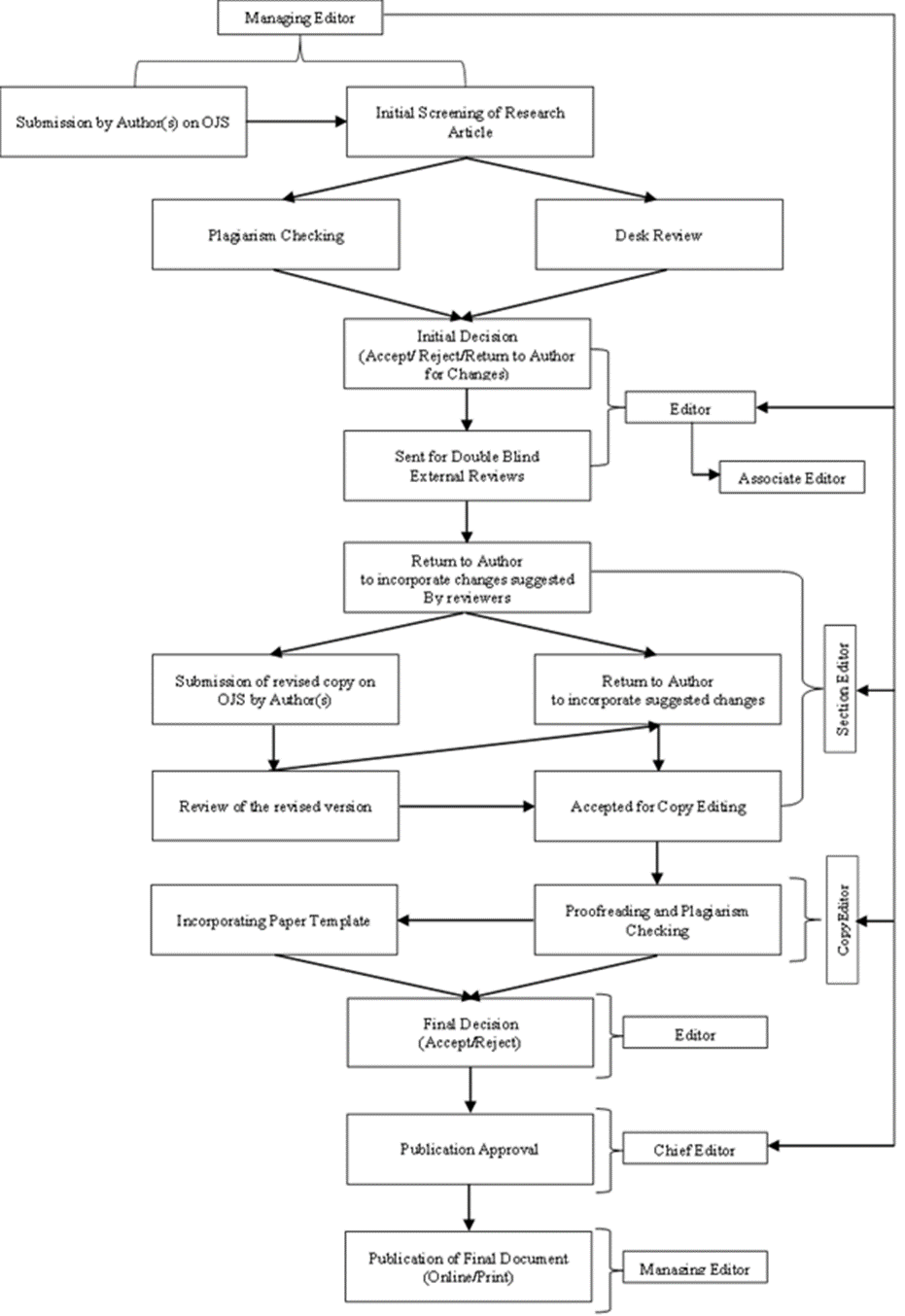
16. Manuscript Processing Workflow
The following steps are followed from manuscript submission to publication:
- Submission of blinded manuscript, title page, and Author Declaration Form.
- Initial screening and plagiarism check by the Managing Editor.
- Desk review and preliminary editorial evaluation.
- Assignment of reviewers by the Editor or Section Editor.
- Double-blind peer review by independent reviewers.
- Communication of reviewer comments to authors.
- Submission of revised manuscript by authors.
- Verification of revisions by the Section Editor.
- Copyediting, proofreading, formatting, and final plagiarism screening.
- Final editorial review and recommendation.
- Approval by the Chief Editor.
- Online publication and issue release by the Managing Editor and Production Team.
17. Article processing and publication fee
The Journal charges a fee of PKR 30,000 for article submission or processing for online publication.
18. Disclosure and Conflicts of Interest
Conflict of interest is a situation in which the process of research and publication may be corrupted, or its results may be biased because of the other interests of its participants. It may concern any one or more of the participants of the research and publication process – the author, the reviewer, or the editor. Conflicts of interest may occur for financial (e.g., Employment opportunities, fees or other compensation arrangements, beneficial ownership of stock) or other reasons (e.g., personal relationships, the pursuit of an academic career, intellectual passion, political involvement, etc.) that can reasonably be expected to influence motivations or results of actions of participants in the publication process.
Conflicts of interest constitute a serious threat to the integrity and objectivity of both scientific research and publishing. Therefore, the best practice for authors, reviewers, and editors alike is to avoid conflicts of interest whenever possible.
All participants in the publication process who are in a situation of a conflict of interest must disclose this fact. Of special importance is that if the original research study reported in the manuscript or the preparation of the manuscript was supported by one or more grants, the title and number of the grant(s) and the name of the institution(s) that provided the grants or financial support to conduct, analyze or write up the study must be specified in the manuscript.
Editors of JREFM may use information disclosed in conflict-of-interest and financial-support statements as a basis for editorial decisions. The corresponding author must notify the editor at the time of submission that there is no conflict of interest to declare or fairly and effectively communicate all conflicts of interest, which will then be acknowledged in the published article.